You need a long resistance band, stable shoes and a non-slip surface. No wall or door anchors are required.
For adults seeking general fitness. If you have an injury, are pregnant, have an illness or need rehabilitation, exercise selection and loading require individual assessment by a qualified healthcare professional.
Exercise 1 of 3
LONG BAND · NO FIXED ANCHORS
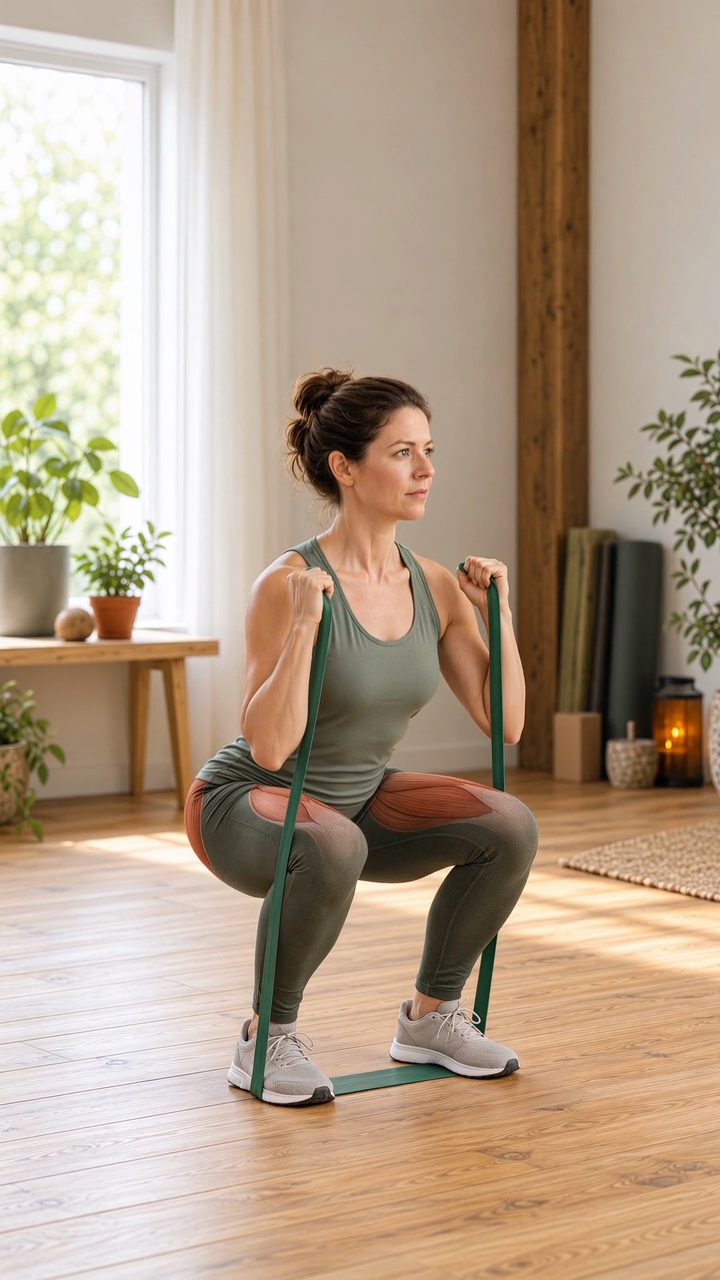
Long-band squat
Bend your knees and hips, then stand up slowly with the band secure under your feet.
Front of thighs (quadriceps)Gluteus maximus
Take care: Check that the band is secure under your shoes. Do not let it run across your neck.
Images and films do not always show protective equipment. Follow the exercise’s equipment requirements and the band manufacturer’s instructions. Flat bands and round tubes can both break or slip free. Keep your face out of the recoil path. Use suitable safety glasses if the manufacturer recommends them or the band could recoil towards your eyes. Ordinary glasses do not replace safety glasses.
The video could not be loaded. The full image, steps and safety information remain available here.
How to do it
Stand hip-width apart with the middle of the band securely under both soles. Hold the ends at your shoulders, in front of your body.
Sit back and down as far as you can with control. Let your knees follow the direction of your toes.
Stand up slowly. Keep your heels on the floor and your hands in the same position.
An easier start: Start with a shallower squat or practise without the band.
Why the muscles work
Your knees and hips straighten as you stand up. The band pulls your hands towards your feet, adding resistance.
Your core helps keep your upper body steady.
A shallow squat is our own simplification of the same movement principle.
Check the band, grip, surface and all anchors before training. Follow the manufacturer’s stretch limit and never release a stretched band. Stop if you feel sharp or increasing pain. If you have chest pain, feel faint or experience unusual breathlessness: stop and seek urgent medical care. Use latex-free material if you have a latex allergy.
General fitness for adults. No independent human exercise or healthcare review has been carried out. A biomechanically derived variation has not automatically been tested for effectiveness or safety.
LONG BAND · NO FIXED ANCHORS
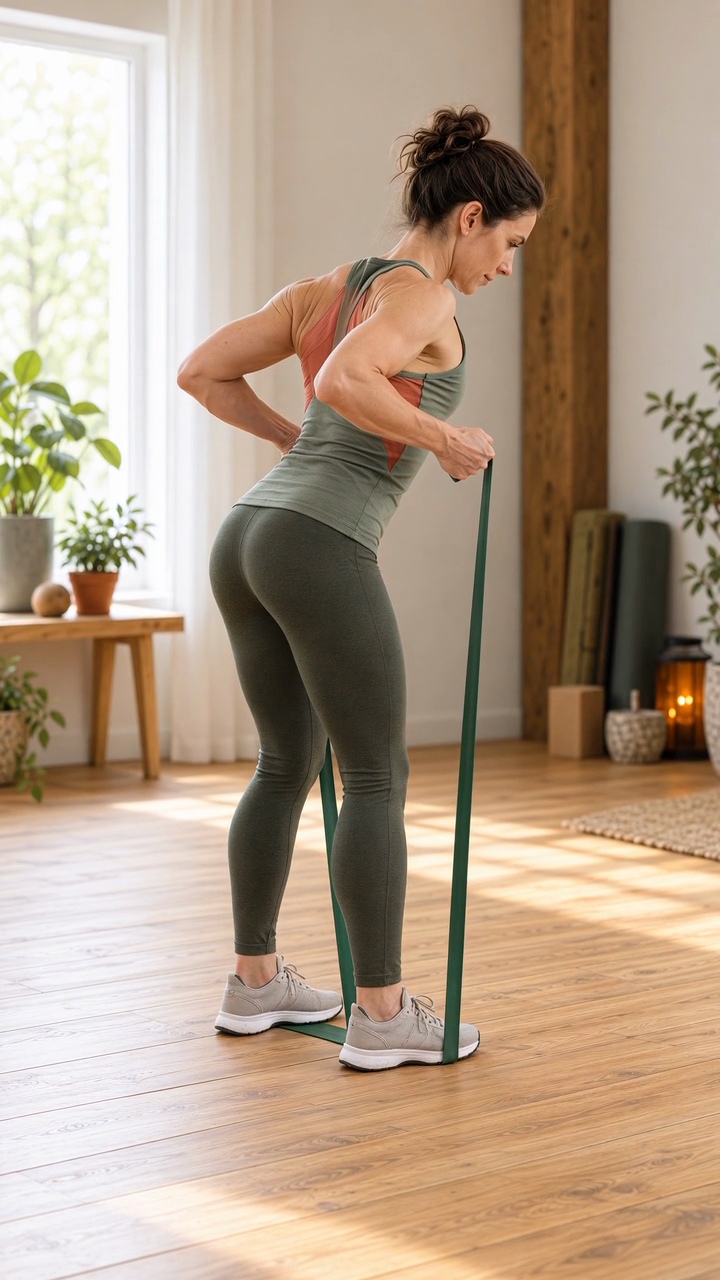
Bent-over row
Draw your elbows back towards your hips, then lower your hands slowly with your back steady.
Latissimus dorsi (large back muscle)Muscles between the shoulder blades
Take care: Use a light band so you can keep your back still. Stop if your back hurts.
Images and films do not always show protective equipment. Follow the exercise’s equipment requirements and the band manufacturer’s instructions. Flat bands and round tubes can both break or slip free. Keep your face out of the recoil path. Use suitable safety glasses if the manufacturer recommends them or the band could recoil towards your eyes. Ordinary glasses do not replace safety glasses.
The video could not be loaded. The full image, steps and safety information remain available here.
How to do it
Stand on the middle of the band with both feet. Hold one end in each hand.
Bend your knees slightly and hinge at your hips. Keep your back in a comfortable, steady position.
Draw your elbows back towards your hips. Lower your hands slowly without rocking your body.
An easier start: Stand more upright and use a shorter pulling movement.
Why the muscles work
Moving your upper arms backwards and bending your elbows works against the downward pull of the band.
The biceps help bend the elbows. Your core keeps your back steady.
The more upright row with a short pull is our own biomechanically derived variation; it has not been tested separately.
Check the band, grip, surface and all anchors before training. Follow the manufacturer’s stretch limit and never release a stretched band. Stop if you feel sharp or increasing pain. If you have chest pain, feel faint or experience unusual breathlessness: stop and seek urgent medical care. Use latex-free material if you have a latex allergy.
General fitness for adults. No independent human exercise or healthcare review has been carried out. A biomechanically derived variation has not automatically been tested for effectiveness or safety.
LONG BAND · NO FIXED ANCHORS
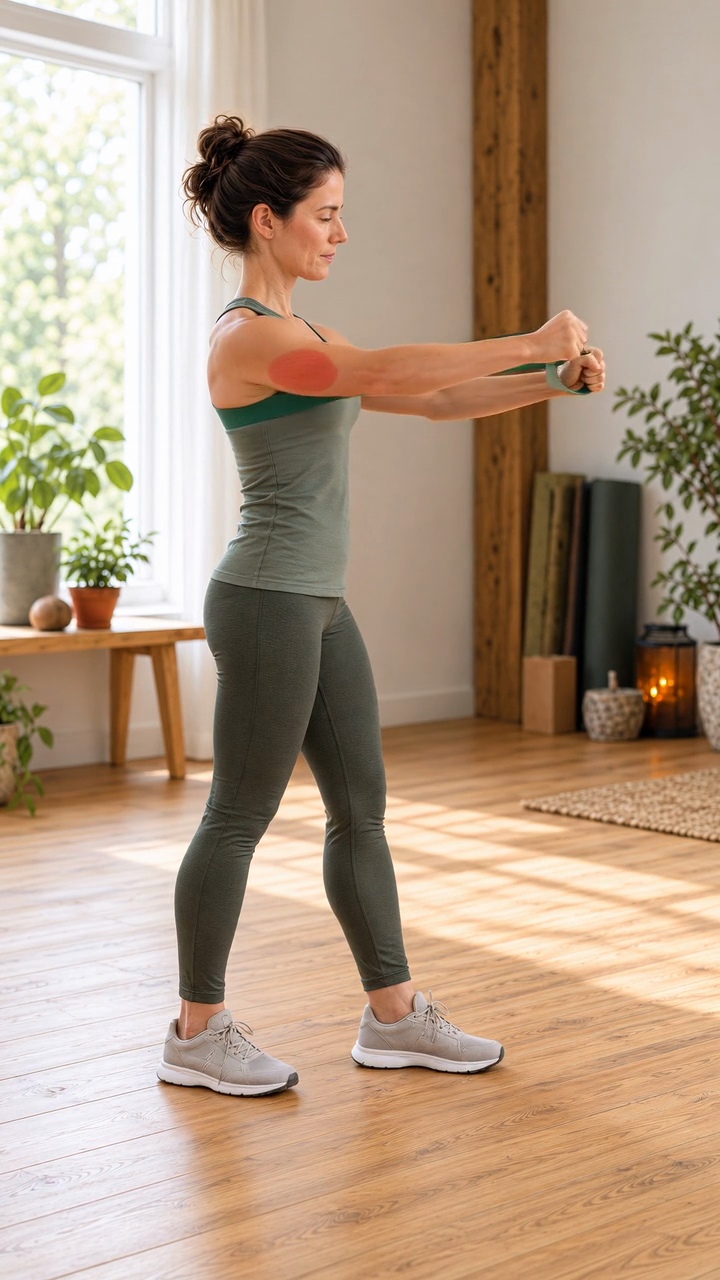
Standing chest press
Press your hands forwards and return slowly, keeping the band across your back below your armpits.
Pectoralis major (chest)Triceps
Take care: The band must stay below your armpits, never against your neck. Shorten the movement if your shoulders feel uncomfortable.
Images and films do not always show protective equipment. Follow the exercise’s equipment requirements and the band manufacturer’s instructions. Flat bands and round tubes can both break or slip free. Keep your face out of the recoil path. Use suitable safety glasses if the manufacturer recommends them or the band could recoil towards your eyes. Ordinary glasses do not replace safety glasses.
The video could not be loaded. The full image, steps and safety information remain available here.
How to do it
Place a long, wide band across your upper back, below your armpits. Hold the ends in your hands.
Stand steadily with one foot slightly ahead of the other. Start with your hands at the sides of your chest.
Press your hands forwards without locking your elbows. Bring them back slowly.
An easier start: Choose a lighter band and a shorter press.
Why the muscles work
Pressing your hands forwards stretches the band behind your back. Your chest muscles and elbow extensors work against its backward pull.
The front of the shoulder also helps with the press.
A staggered stance changes your support; it does not isolate one working muscle.
Check the band, grip, surface and all anchors before training. Follow the manufacturer’s stretch limit and never release a stretched band. Stop if you feel sharp or increasing pain. If you have chest pain, feel faint or experience unusual breathlessness: stop and seek urgent medical care. Use latex-free material if you have a latex allergy.
General fitness for adults. No independent human exercise or healthcare review has been carried out. A biomechanically derived variation has not automatically been tested for effectiveness or safety.
Choose one of the three exercises and explore it at your own pace. This is a fixed walkthrough, not an individual prescription or a complete training programme.
YOUR TRAINING WITH BANDABIT
Start now. Continue at your pace.
TRY IT NOW
Get a feel for it.
Three complete exercises with full images, videos, instructions and safety information. No account needed.